







Newsletter Subscribe
Enter your email address below and subscribe to our newsletter

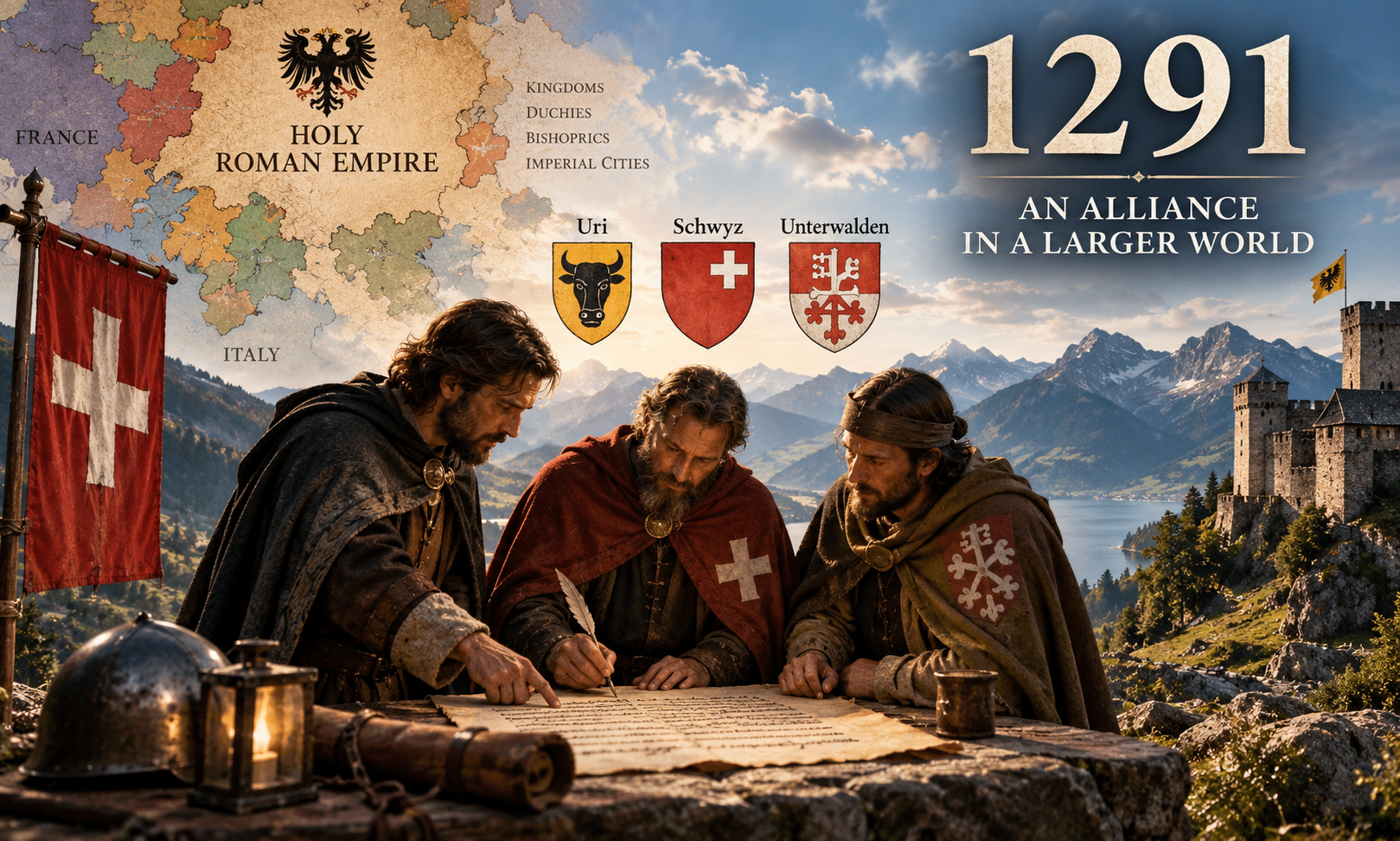
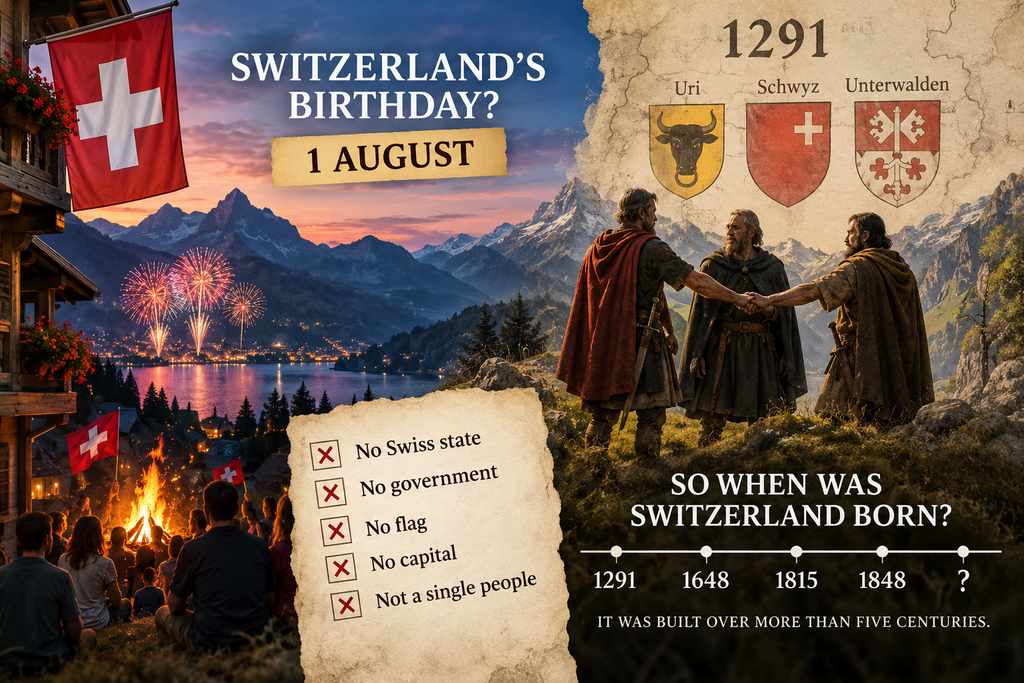
Every year on the first of August, Switzerland celebrates its birthday. Flags appear on balconies. Bonfires burn on mountain slopes. Fireworks explode above lakes and villages.
And somewhere in the story, three men from Uri, Schwyz and Unterwalden meet in a meadow and swear an oath to defend their freedom.
The year is 1291.
It is a powerful story. There is just one problem.
Switzerland was not born in 1291.
There was no Swiss state. No Swiss government. No Swiss flag. No capital.
And the people living in the valleys of Central Switzerland would probably not have thought of themselves as citizens of a country called Switzerland.
What existed instead was something much smaller: an alliance between communities inside the Holy Roman Empire.
Even stranger, for most of Swiss history, 1291 was not celebrated as the obvious birthday of Switzerland at all.
That came much later.
So when was Switzerland actually born? 1291? 1648? 1815? 1848?
The answer depends on what we mean by Switzerland. Because this country was not founded in a single moment.
It was built over more than five centuries.
To understand the beginning, forget the modern map.
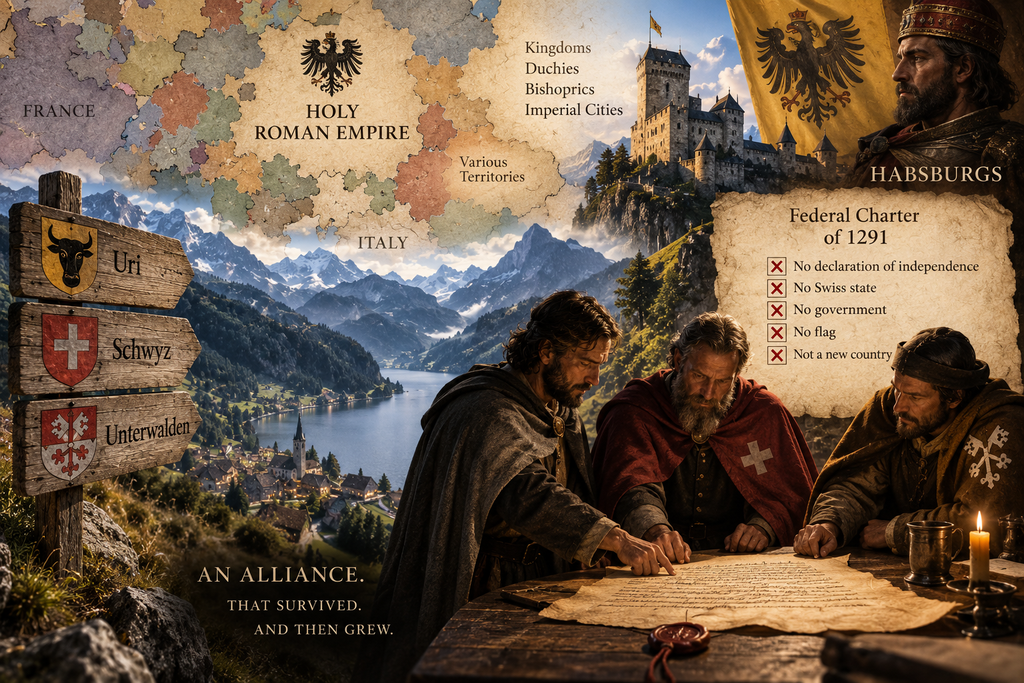
There was no France, Germany, Italy and Switzerland arranged neatly along the borders we recognize today. Medieval Central Europe was a complicated patchwork of kingdoms, duchies, bishoprics, monasteries, imperial cities and territories controlled by noble families.
Much of what is now Switzerland formed part of the Holy Roman Empire. But power within the Empire was fragmented. Some communities enjoyed considerable local autonomy, while others were dominated by powerful noble families.
Among the most influential in the region were the Habsburgs.
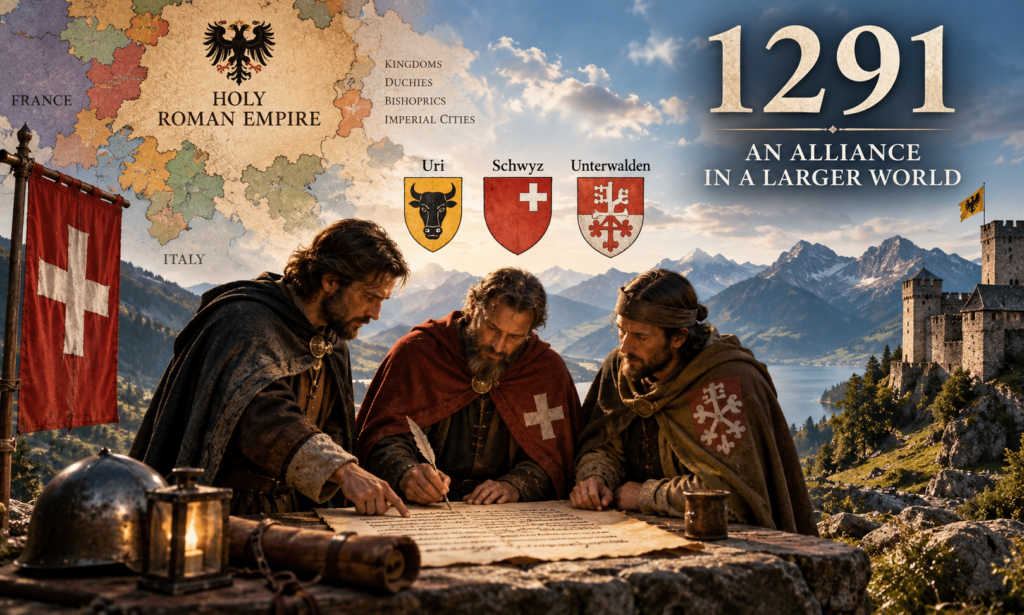
In the mountains of Central Switzerland, several communities wanted to protect their rights and autonomy. They were Uri, Schwyz and Unterwalden.
Around the beginning of August 1291, representatives of these communities made an agreement. Today we know it as the Federal Charter of 1291.
The document promised mutual assistance against outside threats and established rules for dealing with certain disputes. But read it today and something becomes obvious.
There was no declaration of independence. There was no constitution for a new country. There was not even a country called Switzerland.
The charter was an alliance.
And alliances between communities were not unusual in medieval Europe. There was little reason for someone living in 1291 to look at this particular document and think:
A new country has just been born.
But something happened that made this alliance different.
It survived. And then it grew.
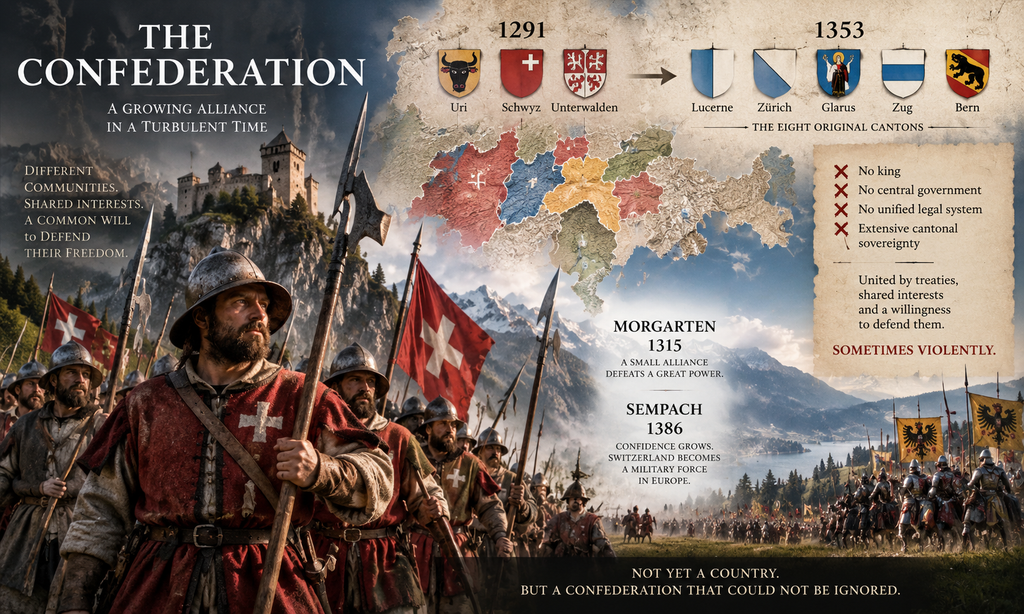
During the 14th century, the network expanded. Lucerne, Zürich, Glarus, Zug and Bern joined the original three communities.
By 1353, eight members formed the core of what became known as the Old Swiss Confederacy.
But calling it a country would still be misleading. The Confederacy had no king, no permanent central government and no unified legal system. Its members retained extensive sovereignty — and they did not always agree.
What held them together was not a modern national identity. It was a network of treaties, shared interests and a growing willingness to defend those interests.
Sometimes violently.
That matters because modern Switzerland is famous for neutrality. Medieval Switzerland was famous for something very different:
Its soldiers.
At battles such as Morgarten in 1315 and Sempach in 1386, forces of the Confederacy defeated Habsburg armies.
Later generations transformed these victories into powerful national stories: mountain communities defeating armoured aristocrats in heroic struggles for freedom.
The reality was more complicated. But the victories had real consequences. The Confederacy became increasingly difficult to dominate from outside — and increasingly confident in its own power.
By the late 15th century, the Swiss were no longer simply defending their territories. They had become a significant military force in Europe.
And for a moment, Switzerland appeared to be moving toward something very different from the neutral country we know today.
It was expanding.
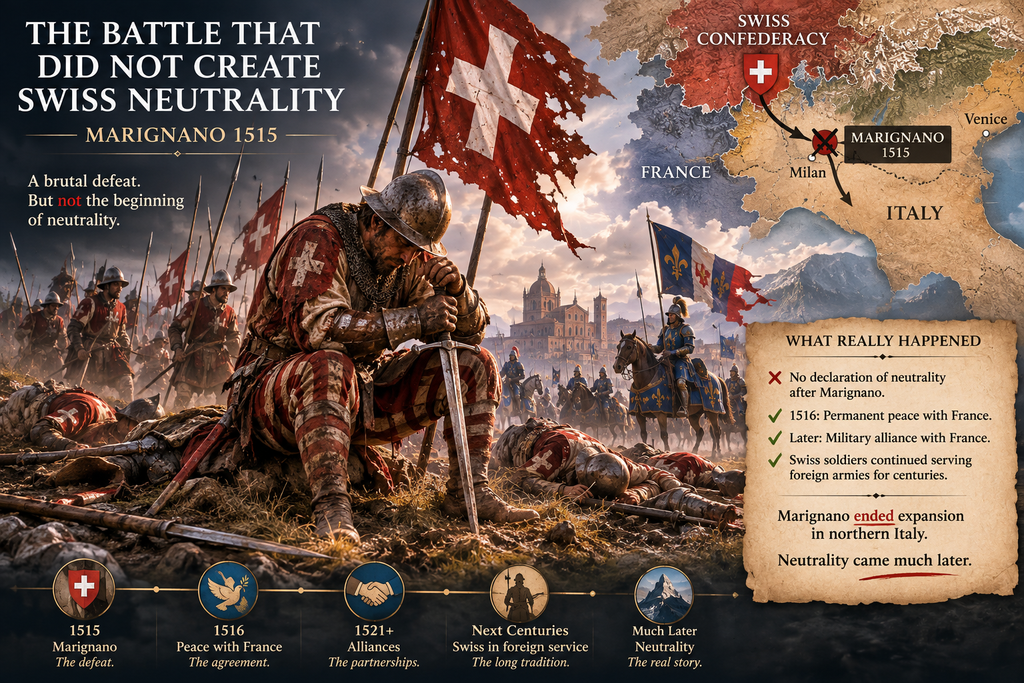
In the early 16th century, Swiss forces became deeply involved in the struggle for northern Italy.
Then came Marignano.
In September 1515, Swiss troops fought the army of the French king Francis I near Milan. The fighting was brutal — and the Swiss lost.
Marignano later became part of a wonderfully simple national story: Switzerland tried expansion, was defeated, learned its lesson and became neutral.
That is not what happened.
There was no declaration of permanent Swiss neutrality after Marignano. In 1516, the Confederates concluded a permanent peace with France. Only a few years later, several Swiss cantons entered into a military alliance with the French crown.
And Swiss soldiers would continue fighting in foreign armies for centuries.
What Marignano did help end was something more specific:
the Confederacy’s attempt to act as an expanding military power in northern Italy.
Swiss neutrality did not begin on a battlefield in 1515. It emerged much more gradually.
And before Switzerland could become neutral toward the outside world, it had to survive enormous divisions inside its own borders.
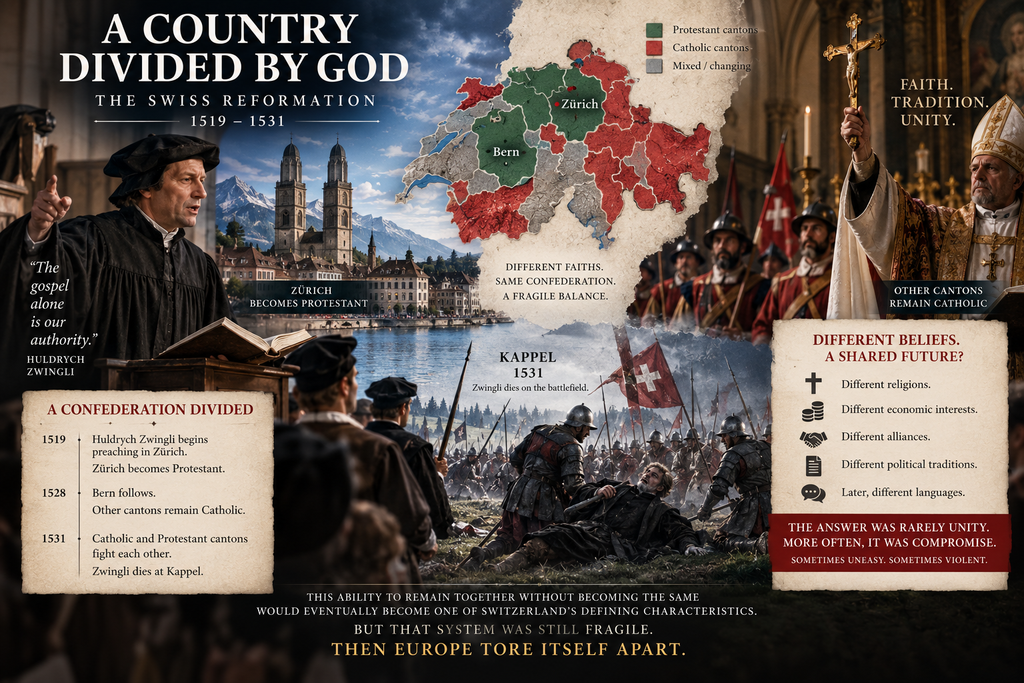
In 1519, a priest named Huldrych Zwingli began preaching in Zürich. His ideas helped launch the Swiss Reformation.
Zürich became Protestant. Bern followed. Other cantons remained Catholic.
The Confederacy was now divided by religion — and these were not peaceful theological disagreements. Catholic and Protestant cantons fought each other.
Zwingli himself died on the battlefield at Kappel in 1531.
Switzerland had discovered a problem that would define much of its history:
How do you keep a political system together when its members fundamentally disagree about what that system should be?
Different religions. Different economic interests. Different alliances. Different political traditions. And later, different languages.
The answer was rarely unity.
More often, it was compromise — sometimes uneasy compromise, sometimes compromise reached only after violence.
This ability to remain together without becoming the same would eventually become one of Switzerland’s defining characteristics.
But that system was still fragile.
Then Europe tore itself apart.
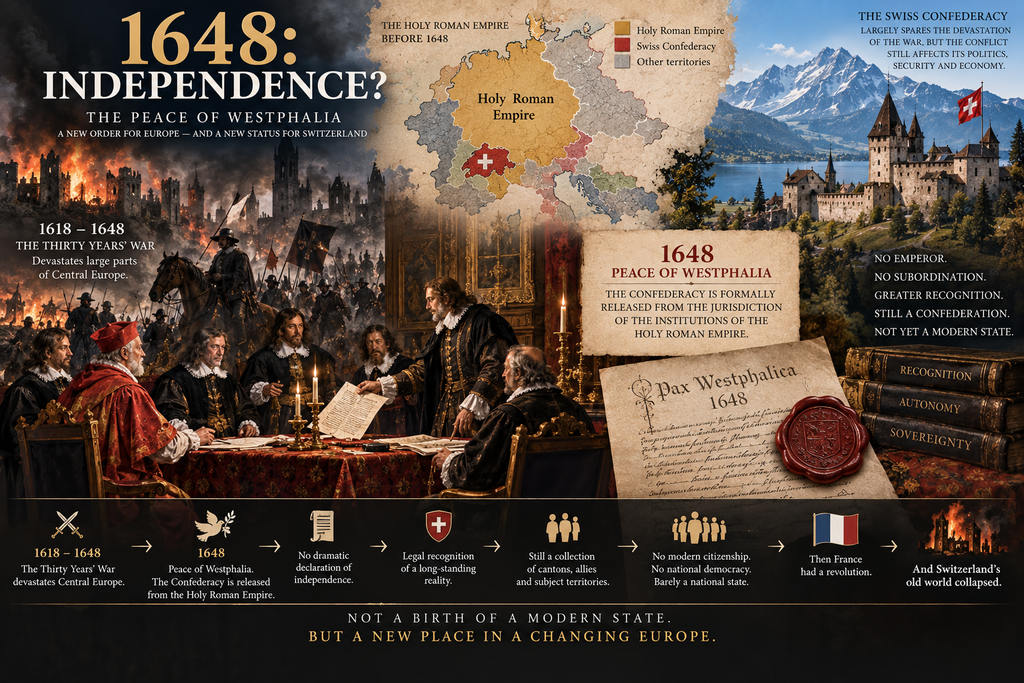
The Thirty Years’ War, from 1618 to 1648, devastated large parts of Central Europe. The Swiss Confederacy largely avoided the destruction suffered by many neighbouring territories, although the war still affected its politics, security and economy.
When the conflict finally ended, Europe was reorganized through the Peace of Westphalia.
And something important happened to Switzerland.
The Confederacy was formally released from the jurisdiction of the institutions of the Holy Roman Empire.
It is tempting to say:
Switzerland became independent in 1648.
But that is too simple.
In practice, the Confederacy had already operated with extensive autonomy for generations. There was no dramatic Swiss declaration of independence, no revolution and no new country appearing overnight.
Instead, Westphalia gave legal recognition to a political reality that had developed gradually.
So perhaps this is Switzerland’s birthday:
1648.
Except Switzerland still did not resemble the country we know today.
The Confederacy remained a complicated collection of sovereign cantons, allies and subject territories. People living within it were not politically equal. There was no modern Swiss citizenship, no national democracy and barely a national state at all.
That system might have continued for much longer.
Then France had a revolution.
And Switzerland’s old world collapsed.
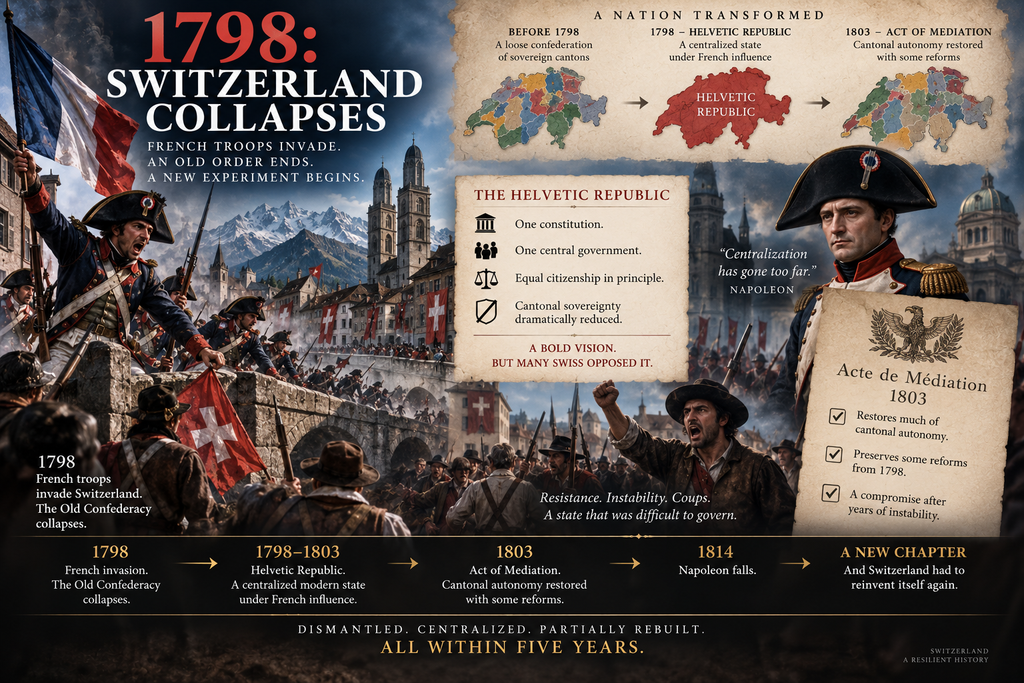
In 1798, French troops invaded Switzerland. The Old Swiss Confederacy collapsed with remarkable speed, sweeping away a political system that had developed over centuries.
In its place came something radically different:
the Helvetic Republic.
For the first time, there was a serious attempt to turn Switzerland into a centralized modern state: one constitution, one central government and equal citizenship in principle.
The sovereignty of the cantons was dramatically reduced.
For anyone looking backward from modern Switzerland, some of this sounds surprisingly familiar. But many Swiss hated it.
The new state had been created under French military pressure and depended heavily on revolutionary France. Resistance, political instability and coups followed.
The Helvetic Republic became increasingly difficult to govern.
Eventually, even Napoleon concluded that centralization had gone too far. In 1803, his Act of Mediation restored much of the cantons’ autonomy while preserving some of the changes introduced after 1798.
Switzerland had been dismantled, centralized and partially rebuilt — all within five years.
Then Napoleon fell.
And Switzerland had to reinvent itself again.
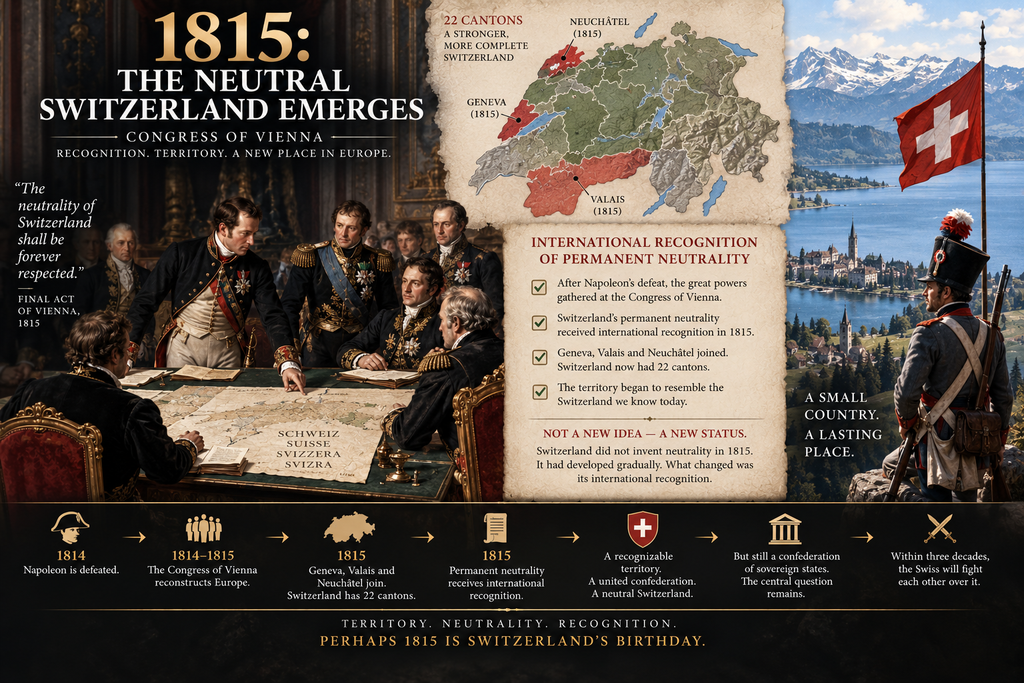
After Napoleon’s defeat, Europe’s great powers gathered to reconstruct the continent.
Switzerland emerged from this process with 22 cantons. Geneva, Valais and Neuchâtel joined, bringing the country’s territory much closer to the Switzerland we recognize today.
And in 1815, following the Congress of Vienna and the final settlement after Napoleon’s defeat, Switzerland’s permanent neutrality received international recognition.
This became one of the foundations of modern Switzerland.
But there is an important distinction:
Switzerland did not suddenly invent neutrality in 1815.
Neutrality had developed gradually through earlier Swiss political practice. What changed in 1815 was its international status.
The European powers now recognized permanent Swiss neutrality as part of the continental order.
So perhaps 1815 is Switzerland’s birthday.
The territory is recognizable. Neutrality is internationally recognized. The cantons are bound together.
But one enormous problem remains.
Switzerland is still essentially a confederation of sovereign states, and the question of how much power the central government should have is becoming increasingly dangerous.
Within three decades, the Swiss will fight each other over it.
This is the part of Swiss history many people outside the country never hear about:
Switzerland had a civil war.
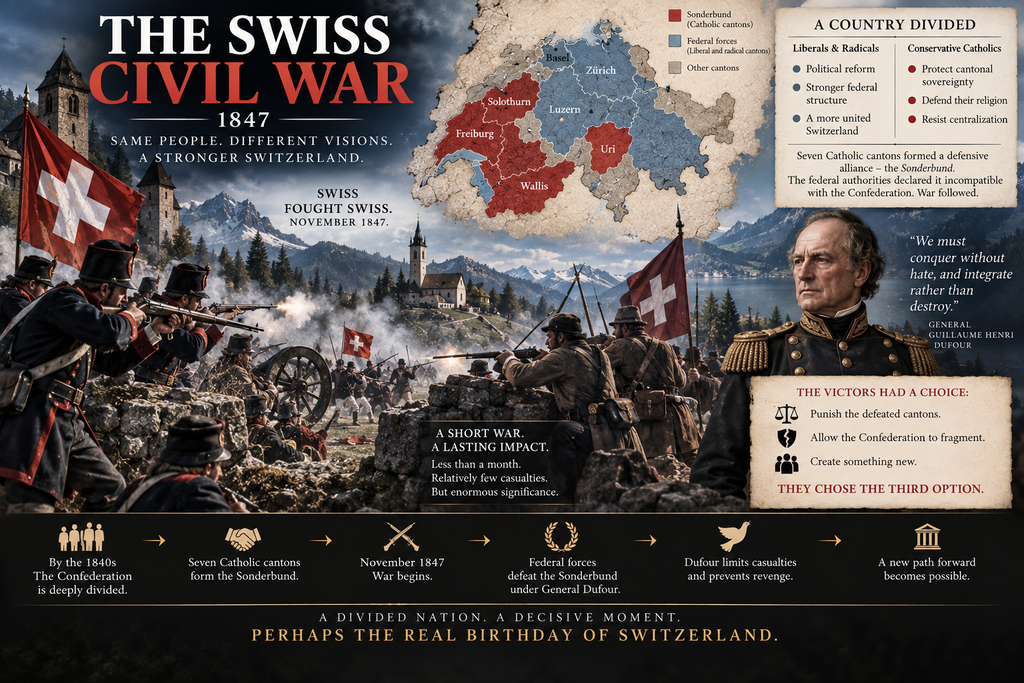
By the 1840s, the Confederation was deeply divided. Liberal and radical movements wanted political reform and a stronger federal structure, while conservative Catholic cantons feared that centralization would threaten both their sovereignty and their religion.
Seven Catholic cantons formed a defensive alliance known as the Sonderbund. The federal authorities declared the alliance incompatible with the Confederation, and the political crisis escalated.
In November 1847, war began.
Swiss fought Swiss.
The conflict lasted less than a month. Compared with the great European wars of the 19th century, the number of casualties was relatively small.
But its significance was enormous.
Federal forces under General Guillaume Henri Dufour defeated the Sonderbund. Dufour deliberately sought to limit casualties and prevent the conflict from turning into a campaign of revenge.
The victors now faced a choice: punish the defeated cantons, allow the Confederation to fragment, or create something new.
They chose the third option.
And this brings us to perhaps the strongest candidate for Switzerland’s real birthday.
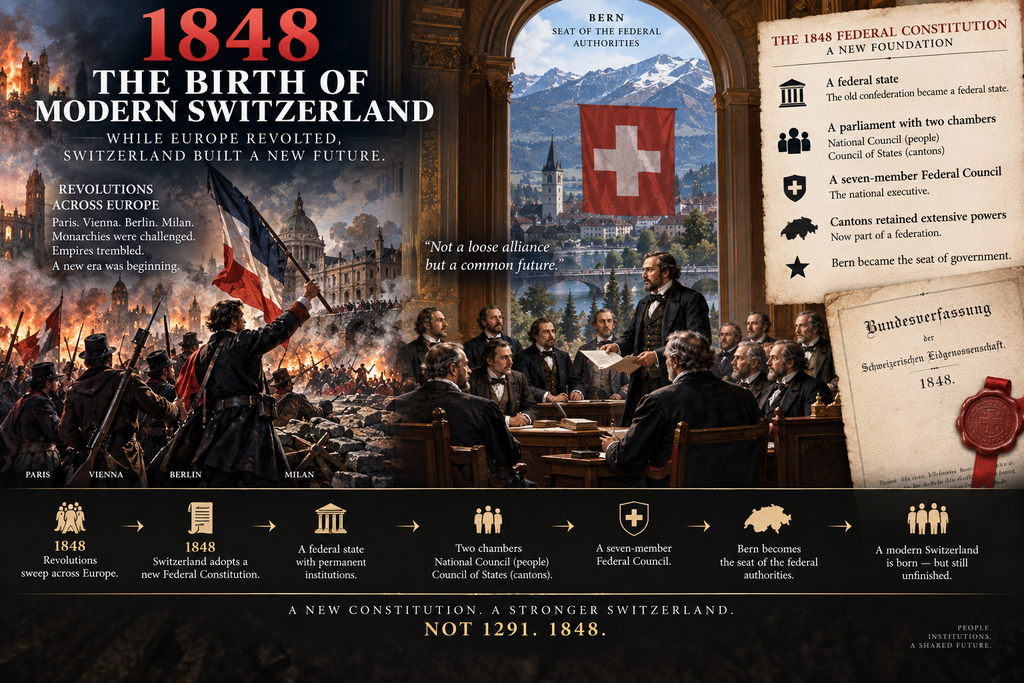
One year later, revolutions swept across Europe. Paris, Vienna, Berlin and Milan were shaken by uprisings. Monarchies were challenged, barricades appeared in cities, and empires struggled to contain liberal and nationalist movements.
Switzerland went in a different direction.
In 1848, it adopted a new Federal Constitution. And this time, the change was fundamental.
The old confederation of sovereign states became a federal state.
Switzerland gained permanent federal institutions: a parliament with two chambers, the National Council representing the population and the Council of States representing the cantons. A seven-member Federal Council became the national executive.
The cantons retained extensive powers, but they were now components of a federation rather than members of a loose alliance. Bern became the seat of the federal authorities.
For the first time, the basic architecture of the Switzerland we know today existed.
The country was still far from the modern democracy it would become. Political rights remained restricted, women would not receive federal voting rights until 1971, and the constitution itself would undergo major revisions.
Modern Switzerland was still unfinished.
But 1848 marks a fundamental break.
If you want the birth of the modern Swiss federal state, this is it.
Not 1291.
1848.
Which creates an obvious question:
If modern Switzerland was created in 1848, why does the country celebrate 1291?
That is where the story becomes really interesting.
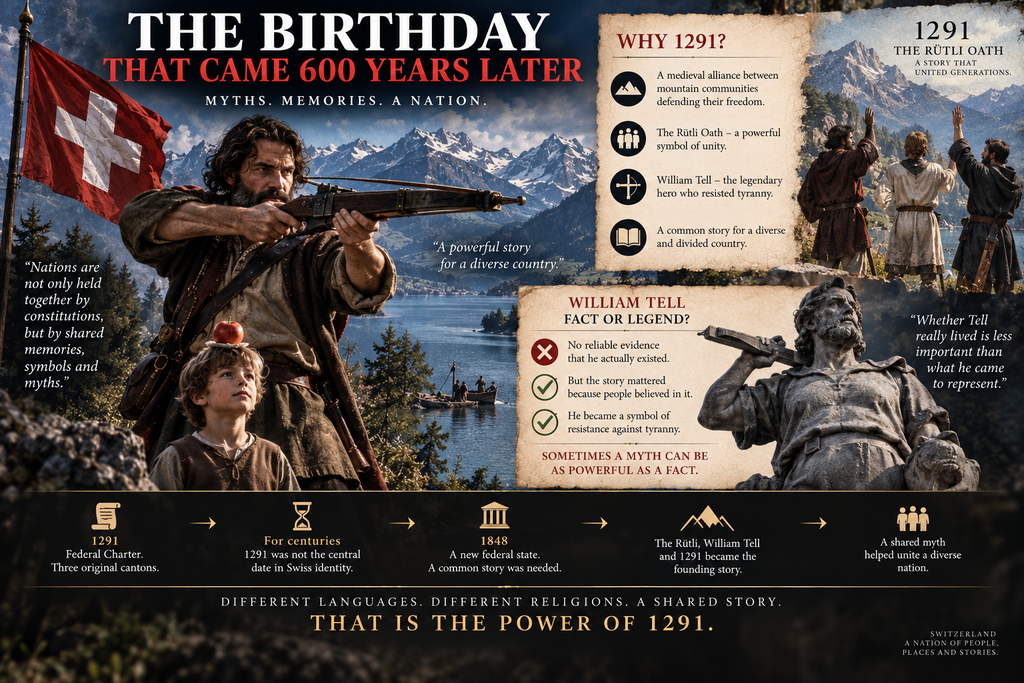
Today, the connection seems obvious: 1291. The Federal Charter. The Rütli. The three original cantons. William Tell. The birth of Switzerland.
But for centuries, 1291 did not occupy the place in Swiss national identity that it does today.
Its transformation into Switzerland’s definitive founding year happened much later — especially in the 19th century.
And the timing matters.
After 1848, the new federal state faced a difficult question:
What exactly united the Swiss?
They did not share one language, one religion or one ethnicity. They had no royal dynasty around which to build a national identity. Cantonal identities remained extremely strong.
And only a few years earlier, Swiss cantons had been shooting at each other in a civil war.
The new country needed a common story.
A medieval alliance between mountain communities defending their freedom was an exceptionally useful one. So was the legendary Rütli Oath.
And so was Switzerland’s most famous hero:
William Tell.
According to the legend, Tell refused to bow before the Habsburg official Gessler. He was forced to shoot an apple from the head of his own son. He succeeded and eventually killed Gessler, becoming a symbol of resistance against tyranny.
It is one of the most famous stories in Swiss history.
There is just one problem:
There is no reliable evidence that William Tell actually existed.
But historically, that almost misses the point. Tell mattered because people believed in the story.
Nations are not held together by constitutions alone. They are also held together by shared memories, symbols and myths.
And the new Switzerland needed them.
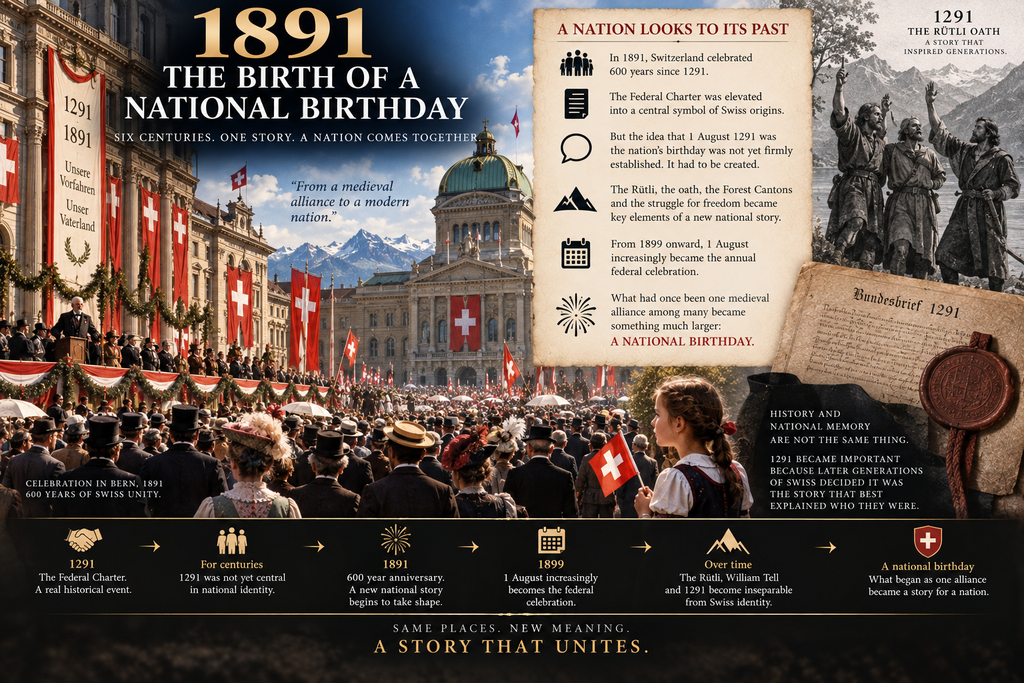
Six hundred years after the Federal Charter, Switzerland organized a major national anniversary.
In 1891, the Confederation celebrated 600 years since 1291, elevating the Federal Charter into a central symbol of Swiss origins.
But contemporary debate reveals something fascinating:
The idea that 1 August 1291 was obviously Switzerland’s birthday was not yet deeply embedded in popular consciousness.
It had to be established.
The medieval past was being transformed into a modern national story: the Rütli, the oath, the Forest Cantons, the struggle for freedom — and 1291.
Over time, these elements became inseparable from the way Switzerland explained its own existence.
From 1899 onward, the first of August increasingly became established as the annual federal celebration.
Eventually, what had once been one medieval alliance among many became something much larger:
A national birthday.
In a strange way, Switzerland’s founding story was itself built centuries after the supposed founding.
But that does not mean the story of 1291 is simply false.
Uri, Schwyz and Unterwalden really did form an alliance. The Federal Charter really exists. And the medieval Confederacy really did grow from networks of alliances in this region.
The crucial distinction is this:
History and national memory are not the same thing.
1291 became important not only because of what happened in the Middle Ages.
It became important because later generations of Swiss decided that this was the story that best explained who they were.
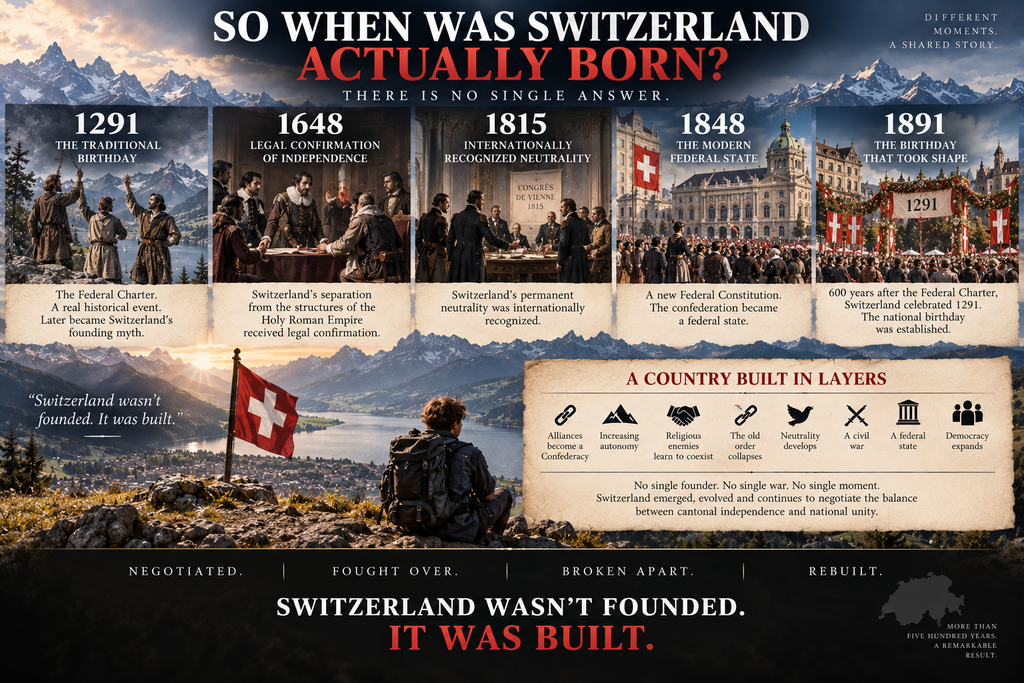
There is no single answer.
If you want the traditional birthday, choose 1291.
If you want the moment Switzerland’s separation from the structures of the Holy Roman Empire received legal confirmation, choose 1648.
If you want internationally recognized permanent neutrality, choose 1815.
If you want the birth of the modern Swiss federal state, choose 1848.
And if you want to understand why Switzerland celebrates 1291 as its birthday in the first place, you have to look much later: 1891.
That may sound confusing. But it reveals something fundamental about Switzerland.
There was no king who created this country. No revolutionary leader who declared it independent. No single war of independence. No moment when everyone gathered around a map and decided to create Switzerland.
Instead, the country emerged in layers.
Alliances became a Confederacy. The Confederacy became increasingly autonomous. Religious enemies learned to coexist. The old order collapsed. Neutrality developed. The cantons fought a civil war.
And from that crisis emerged a federal state designed to keep very different communities together without forcing them to become identical.
Even then, the country continued to evolve. Swiss democracy expanded, political rights expanded, and the federal system changed. Switzerland continues to negotiate the balance between cantonal independence and national unity today.
So perhaps asking for Switzerland’s exact birthday is asking the wrong question.
Because Switzerland was never really founded.
It was negotiated. Fought over. Broken apart. Rebuilt.
And eventually transformed from a network of medieval alliances into one of the world’s most unusual federal states.
It took more than five hundred years.
And perhaps that explains Switzerland better than any founding legend ever could.
Switzerland wasn’t founded.
It was built.